
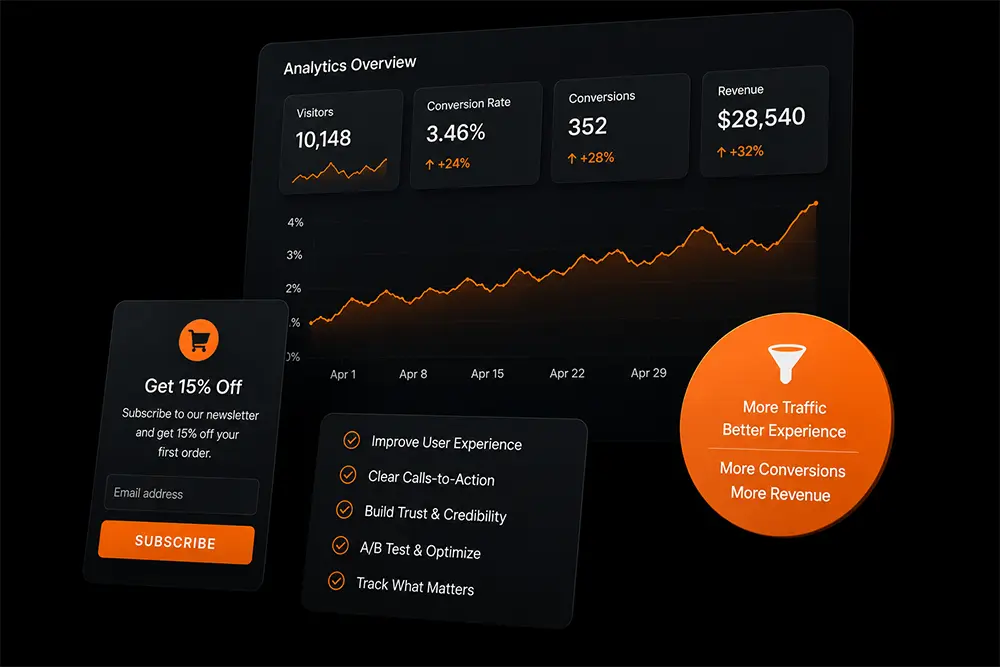
Every business wants more website traffic, but traffic alone doesn’t generate revenue. If visitors aren’t taking action once they arrive, you’re leaving money on the table.
Conversion Rate Optimization (CRO) is the process of improving your website so more visitors become customers, subscribers, or qualified leads. Instead of spending more money to attract new traffic, CRO helps you get better results from the traffic you already have.
Whether you run an ecommerce store or a service-based business, even small improvements in your conversion rate can have a significant impact on your bottom line.
What Is Conversion Rate Optimization?
Conversion Rate Optimization is the practice of increasing the percentage of visitors who complete a desired action on your website.
That action might be:
- Purchasing a product
- Filling out a contact form
- Booking a consultation
- Downloading a guide
- Joining your email list
- Requesting a quote
For example, if 5,000 people visit your website each month and 100 of them become customers, your conversion rate is 2%. Improving that to 3% means 50 additional customers without increasing your advertising budget.
Why CRO Matters
Many businesses immediately invest more in Google Ads, SEO, or social media when sales slow down.
While increasing traffic is important, it’s often more profitable to improve the website itself first.
Imagine this:
- Monthly visitors: 10,000
- Current conversion rate: 2%
- Monthly conversions: 200
Now improve the conversion rate to 3%.
Without spending another dollar on advertising, your monthly conversions increase to 300—a 50% improvement.
This is why CRO is one of the highest ROI marketing investments available.
1. Improve Your Page Speed
Slow websites lose customers.
Research consistently shows that users expect pages to load almost instantly. Every additional second increases the likelihood they’ll leave before taking action.
Improve performance by:
- Compressing images
- Removing unnecessary plugins
- Using caching
- Optimizing code
- Choosing quality hosting
A faster website creates a better user experience and often improves both conversions and search rankings.
2. Create Clear Calls-to-Action
Visitors should never wonder what to do next.
Every important page should have a primary call-to-action that’s obvious and easy to find.
Examples include:
- Book a Free Consultation
- Get a Quote
- Start Your Free Trial
- Schedule a Demo
- Shop Now
Avoid competing buttons that distract users from your primary goal.
3. Reduce Form Friction
Long forms discourage conversions.
Only ask for information you actually need.
Instead of requesting:
- Full address
- Company size
- Budget
- Industry
- Phone number
- Multiple custom fields
Start with:
- Name
- Phone (if necessary)
- Message
You can always collect additional information later.
4. Build Trust Immediately
People rarely buy from businesses they don’t trust.
Include trust signals throughout your website, such as:
- Google Reviews
- Customer testimonials
- Case studies
- Certifications
- Awards
- Security badges
- Client logos
Social proof reassures visitors they’re making the right decision.
5. Write Headlines That Focus on Benefits
Many websites describe features instead of outcomes.
Compare these headlines:
❌ Professional Marketing Services
✅ Generate More Qualified Leads Through Data-Driven Marketing
The second explains the result customers actually care about.
Always focus on benefits before features.
6. Simplify Navigation
Too many choices create decision fatigue.
Visitors should quickly understand:
- What you offer
- Who it’s for
- How to contact you
A clean navigation menu with fewer options often performs better than one overloaded with links.
7. Use Better Images
Visuals influence buying decisions.
Instead of generic stock photography, use:
- Real team photos
- Actual products
- Customer success stories
- Behind-the-scenes content
- Original project images
Authentic visuals increase credibility and engagement.
8. Optimize for Mobile
More than half of website traffic now comes from mobile devices.
Your website should provide an excellent experience on every screen size.
Pay particular attention to:
- Button sizes
- Readable typography
- Fast loading
- Easy navigation
- Mobile-friendly forms
A poor mobile experience often results in lost sales.
9. Test Everything
One of the biggest mistakes businesses make is assuming they already know what works.
Instead, test variations of:
- Headlines
- Button colors
- Images
- Calls-to-action
- Form layouts
- Pricing displays
- Page layouts
Small improvements often compound into significant revenue gains.
10. Measure the Right Metrics
Don’t focus only on page views.
Instead, monitor metrics that indicate real business growth, including:
- Conversion rate
- Revenue per visitor
- Cost per acquisition
- Bounce rate
- Cart abandonment
- Form completion rate
- Average order value
These numbers provide a much clearer picture of website performance.
CRO Is an Ongoing Process
Conversion optimization isn’t something you do once.
Customer behavior changes.
Competitors evolve.
New technologies emerge.
The highest-performing websites are continuously tested, refined, and improved over time.
The goal isn’t to build the perfect website—it’s to build a website that gets better every month.
How Direct Route Design Improves Conversion Rates
At Direct Route Design, we don’t just build websites that look good—we build websites that generate measurable business results.
Our CRO process includes:
User Experience Analysis
We identify friction points that prevent visitors from taking action.
Landing Page Optimization
We design pages that guide users naturally toward conversion.
Conversion Tracking
Every important action is tracked so performance can be measured accurately.
A/B Testing
We continually test layouts, messaging, and calls-to-action to improve results over time.
Performance Optimization
Fast-loading websites create better user experiences and higher conversion rates.
Final Thoughts
Increasing traffic is only half the equation.
The businesses that grow consistently are the ones that maximize every visitor they already receive.
By improving your website’s speed, messaging, usability, and user experience, Conversion Rate Optimization helps turn more visitors into customers—without increasing your advertising budget.
If you’re investing in SEO, Google Ads, or social media, CRO ensures that traffic produces the highest possible return.
Frequently Asked Questions
What is a good conversion rate?
It varies by industry, but many websites convert between 2% and 5%. High-performing landing pages often achieve significantly higher conversion rates.
How long does CRO take?
Some improvements produce immediate results, while ongoing testing and optimization typically deliver the greatest gains over several months.
Does CRO help SEO?
Indirectly, yes. A faster website, better user experience, and improved engagement can positively influence search performance.
Should I focus on CRO before increasing advertising?
In many cases, yes. Improving conversions first allows you to generate more leads or sales from your existing traffic before investing in additional advertising.
Ready to Turn More Visitors Into Customers?
At Direct Route Design, we combine strategic web design, UX optimization, and data-driven testing to help businesses maximize every website visitor.
Contact us today to learn how Conversion Rate Optimization can help your website generate more leads, more sales, and a better return on your marketing investment.