
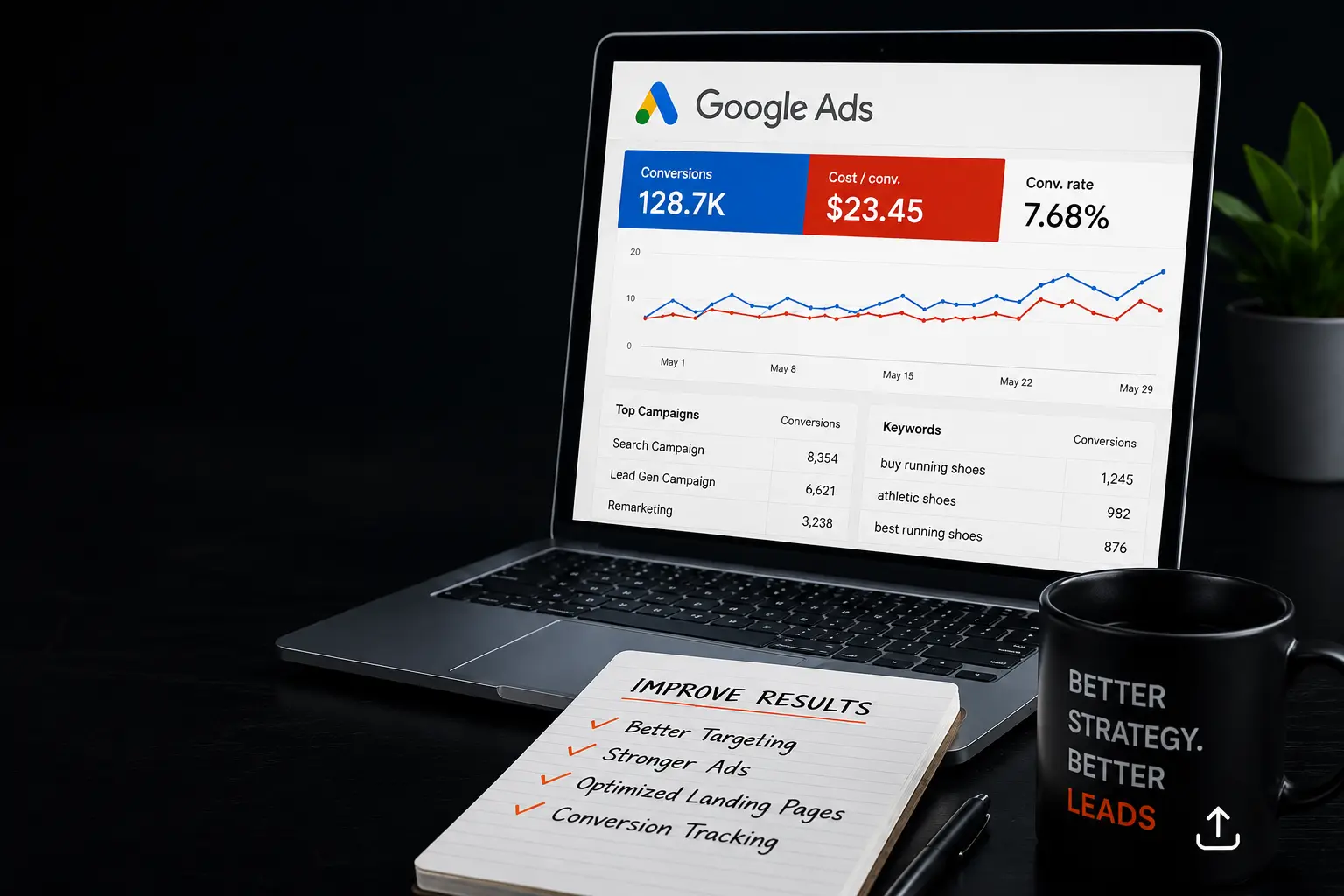
If you’re investing in Google Ads but not seeing consistent leads, you’re not alone. Many businesses spend hundreds or even thousands of dollars each month on pay-per-click (PPC) advertising without achieving the return they expected.
The good news is that the issue usually isn’t Google Ads itself—it’s how the campaign is built and managed.
From targeting the wrong keywords to sending traffic to underperforming landing pages, several factors can prevent a campaign from delivering results. In this guide, we’ll explore the most common reasons Google Ads campaigns fail and what you can do to improve lead quality and maximize your return on investment.
Why Google Ads Can Be So Effective
Google Ads allows your business to appear in front of people actively searching for your products or services. Unlike social media advertising, where you’re interrupting someone’s browsing experience, Google Ads targets users with existing intent.
For example, someone searching for “emergency roofer near me” or “SEO company Montreal” is already looking for a solution. The goal is to ensure your business appears at the right moment with the right message.
When managed properly, Google Ads can provide:
- Highly qualified leads
- Immediate visibility
- Measurable ROI
- Flexible budgeting
- Scalable growth
However, success depends on much more than simply launching a campaign.
Common Reasons Google Ads Campaigns Fail
Targeting the Wrong Keywords
One of the biggest mistakes businesses make is choosing keywords that are either too broad or unrelated to their services.
For example, a local landscaping company targeting “landscaping” may receive searches for landscaping ideas, landscaping jobs, or DIY projects instead of potential customers looking to hire a contractor.
Successful campaigns focus on keywords with strong buying intent, such as:
- Landscaping company near me
- Website designer in Montreal
- Emergency plumber
- Google Ads management services
The more closely your keywords match what your ideal customer is searching for, the higher your chances of generating qualified leads.
Ignoring Negative Keywords
Negative keywords prevent your ads from appearing for irrelevant searches.
Without them, your budget can quickly be wasted on clicks from people who aren’t potential customers.
Common negative keywords include:
- Free
- Jobs
- Salary
- DIY
- Course
- Training
- Template
Reviewing search terms regularly is one of the most effective ways to reduce wasted ad spend.
Sending Traffic to the Wrong Landing Page
Your website plays a major role in campaign performance.
Sending users to a generic homepage often creates unnecessary friction. Instead, every ad should direct visitors to a dedicated landing page that matches their search intent.
An effective landing page should include:
- A clear headline
- A strong call-to-action
- Trust signals such as reviews or testimonials
- Fast loading speeds
- Mobile-friendly design
- Easy-to-complete contact forms
A great landing page can significantly improve your conversion rate without increasing your advertising budget.
Weak Ad Copy
Your ad is often the first impression potential customers have of your business.
Generic headlines like “Best Services” or “Professional Company” fail to communicate value.
Instead, focus on what makes your business different.
Examples include:
- Free Estimates
- Certified Professionals
- Same-Day Service
- Over 10 Years of Experience
- Five-Star Rated
- Locally Owned & Operated
Strong calls-to-action also encourage users to click, such as:
- Request a Free Quote
- Book Your Consultation
- Call Today
Not Tracking Conversions
Many businesses only track clicks.
Clicks don’t pay the bills—conversions do.
Proper conversion tracking should include:
- Contact form submissions
- Phone calls
- Quote requests
- Online bookings
- Purchases
Without accurate conversion data, it’s impossible to know which keywords and ads are actually generating revenue.
Quality Score Matters
Google assigns every keyword a Quality Score based on several factors, including:
Ad Relevance
Your ad should closely match the user’s search.
Landing Page Experience
The destination page should load quickly, provide useful information, and match the intent of the search.
Expected Click-Through Rate
Ads that consistently attract clicks are rewarded with higher Quality Scores.
Improving Quality Score often reduces your cost per click while improving ad positions.
The Importance of Ongoing Campaign Optimization
Google Ads isn’t a “set it and forget it” platform.
Successful campaigns require regular optimization.
This includes:
- Reviewing search terms
- Adding negative keywords
- Testing new headlines
- Improving landing pages
- Adjusting bids
- Monitoring conversion data
- Refining audience targeting
Small improvements over time often lead to significant increases in lead quality and return on investment.
Should You Use AI to Manage Google Ads?
Artificial intelligence has become a valuable tool for advertisers.
Google’s Smart Bidding strategies can help optimize campaigns by adjusting bids based on user behavior and likelihood to convert.
However, AI still requires human oversight.
Without proper campaign structure, keyword targeting, and conversion tracking, automated bidding can quickly spend your budget inefficiently.
The best results come from combining automation with experienced campaign management.
How Direct Route Design Manages Google Ads
At Direct Route Design, we build Google Ads campaigns designed to generate qualified leads—not just website traffic.
Our process includes:
Keyword Research
We identify high-intent keywords that are most likely to generate new business.
Landing Page Optimization
Every campaign is supported by pages designed specifically to convert visitors into customers.
Conversion Tracking
We track phone calls, contact forms, and other valuable actions to accurately measure campaign performance.
Continuous Optimization
Campaigns are monitored and refined regularly to improve results and reduce wasted spend.
Transparent Reporting
You’ll always know how your campaigns are performing through clear reporting and measurable data.
Signs It’s Time to Hire a Google Ads Professional
If your campaigns are experiencing any of the following, professional management may help:
- High ad spend with few leads
- Low conversion rates
- Poor lead quality
- Rising cost per click
- No conversion tracking
- Limited understanding of campaign performance
An experienced Google Ads manager can identify issues quickly and implement strategies that improve performance over time.
Final Thoughts
Google Ads can be one of the most effective ways to generate new business, but success depends on strategy, optimization, and continuous improvement.
Rather than focusing solely on clicks, successful campaigns prioritize lead quality, conversion tracking, and landing page performance.
With the right approach, Google Ads can become a reliable source of qualified leads and long-term business growth.
Frequently Asked Questions
How much should I spend on Google Ads?
Your budget depends on your industry, competition, and goals. Many local businesses start with a modest monthly budget and increase spending as campaigns become profitable.
How long does it take for Google Ads to work?
Google Ads can begin generating traffic immediately after launch, but campaigns often require several weeks of optimization before reaching peak performance.
Is Google Ads better than SEO?
Neither is inherently better—they serve different purposes. Google Ads provides immediate visibility, while SEO builds long-term organic traffic. Many businesses achieve the best results by using both together.
Can I manage Google Ads myself?
Yes, but successful campaigns require ongoing monitoring, keyword optimization, conversion tracking, and testing. Many businesses find professional management leads to better performance and a stronger return on investment.
Ready to Generate More Qualified Leads?
Whether you’re launching your first campaign or looking to improve an existing one, Direct Route Design can help you maximize your advertising budget with data-driven Google Ads management.
Contact us today for a free Google Ads consultation and discover how strategic PPC management can help grow your business.